Equipping Leaders. Developing Competencies. Building a Nation.
The Graduate School of Public Management
Equipping Leaders. Developing Competencies. Building a Nation.
About DAP GSPM
The Graduate School of Public Management (GSPM) is the academic arm of DAP and offers graduate degree programs and short courses in public management and productivity using a multidisciplinary approach. Its three core functions are instruction, research, and extension.
To create societal impact through quality educational programs, research, and extension services for development managers and institutions
Mission
By 2030, GSPM will be a premier education, research, and innovation hub for global leaders and innovators
Vision
Core Values
Core Values
History
The Development Academy of the Philippines (DAP) began implementing the Master in Public Management (MPM) program in 1991 by virtue of Board Resolution No. 02-91.
1970
This period depicted an era of reform and cultural growth in the Philippines. It was a time that called for a new generation of leaders that would steer the country towards a path of productivity, innovation, and development.
During those days in martial law, as part of the early part of martial law, one of the questions asked by OD Corpuz was, why is it that the military has a Philippine military academy to train officers for bigger jobs, while we don’t have an equivalent in the civilian sector? That was the seminal idea that developed into the formation of the Development Academy of the Philippines.
1994
As the DAP continues to embody the synergistic relationship between the people, government, and other institutions, the Graduate School of Public and Development Management, or GSPDM, was established to fulfill the Academy’s development education mandate by virtue of DAP Board Resolution No. 94-01. The Graduate School was formally instituted on January 17, 1994.
As a higher education institution, the GSPDM remains steadfast as the DAP’s academic arm in forging transformative learning, innovation, and competencies in the public, private, and NGO sectors
Originally, it was not GSPDM, it was a single course — Master in Public Management, which was offered during the time of President Carm Abella. Her intention really was to make sure that we have a training program that is degree oriented and focused on individuals that are part of the Philippine bureaucracy.
Then during the term of Dr. Eduardo Gonzalez, they organized it into a school. One is towards the MPM itself. And then they organized another one MPQM – Master in Productivity and Quality Management.
So rather than just a public offering, the Graduate School started focusing on agencies so that it becomes more relevant to the needs and requirements of those agencies.
As an institution for higher learning. The DAP-GSPDM is strategically establishing itself as the country’s research hub for Public Management Knowledge. Aside from academic degree programs and certificate Courses, the GSPDM conducts action, research, and analysis to provide evidence based recommendations to the government as part of the Master in Public Management Program.
One of the things the Research Fellows always remind the Graduate School about is that it should be able to address issues that will be picked out by policymakers. Otherwise, it’s just stale information. So the Research Fellows inform the writers that they should write policy recommendations and that they should provide the evidence to support these recommendations, as if they’re convincing a policymaker.
In support of the country’s goal to achieve sustainable development and make contributions to the global community, the GSPDM spearheads research initiatives that would generate new knowledge, data, and evidence for innovation and change essential for sustainable development.
GSPDM has a budding niche for the research, and just have formally launched the research program of the GSPDM, really geared towards the United Nations Sustainable Development Goals.
For the first time there is a committee in the Senate on Sustainable Development Goals, Innovation, and Futures Thinking. Senator Pia Cayetano moved that there should be this committee and she chairs the committee.
The Academy and its Graduate School of Public Development and Management remains steadfast in its mission to mold an agile, resilient, and transformative public and development sector in this ever changing landscape of Philippine politics and the nation as a whole.
2014
CHED issued Certification No. 14-07-398 which ascertained the inclusion of DAP, through GSPDM, in the roster of Philippine higher education institutions. CHED also recognized the various program offerings under the GSPDM.
History
1970s
This period depicted an era of reform and cultural growth in the Philippines. It was a time that called for a new generation of leaders that would steer the country towards a path of productivity, innovation, and development.
During those days in martial law, as part of the early part of martial law, one of the questions asked by OD Corpuz was, why is it that the military has a Philippine military academy to train officers for bigger jobs, while we don’t have an equivalent in the civilian sector? That was the seminal idea that developed into the formation of the Development Academy of the Philippines.
1994
As the DAP continues to embody the synergistic relationship between the people, government, and other institutions, the Graduate School of Public and Development Management, or GSPDM, was established to fulfill the Academy’s development education mandate by virtue of DAP Board Resolution No. 94-01. The Graduate School was formally instituted on January 17, 1994.
As a higher education institution, the GSPDM remains steadfast as the DAP’s academic arm in forging transformative learning, innovation, and competencies in the public, private, and NGO sectors.
Originally, it was not GSPDM, it was a single course — Master in Public Management, which was offered during the time of President Carm Abella. Her intention really was to make sure that we have a training program that is degree oriented and focused on individuals that are part of the Philippine bureaucracy.
Then during the term of Dr. Eduardo Gonzalez, they organized it into a school. One is towards the MPM itself. And then they organized another one MPQM – Master in Productivity and Quality Management.
So rather than just a public offering, the Graduate School started focusing on agencies so that it becomes more relevant to the needs and requirements of those agencies.
As an institution for higher learning. The DAP-GSPDM is strategically establishing itself as the country’s research hub for Public Management Knowledge. Aside from academic degree programs and certificate Courses, the GSPDM conducts action, research, and analysis to provide evidence based recommendations to the government as part of the Master in Public Management Program.
One of the things the Research Fellows always remind the Graduate School about is that it should be able to address issues that will be picked out by policymakers. Otherwise, it’s just stale information. So the Research Fellows inform the writers that they should write policy recommendations and that they should provide the evidence to support these recommendations, as if they’re convincing a policymaker.
In support of the country’s goal to achieve sustainable development and make contributions to the global community, the GSPDM spearheads research initiatives that would generate new knowledge, data, and evidence for innovation and change essential for sustainable development.
GSPDM has a budding niche for the research, and just have formally launched the research program of the GSPDM, really geared towards the United Nations Sustainable Development Goals.
For the first time there is a committee in the Senate on Sustainable Development Goals, Innovation, and Futures Thinking. Senator Pia Cayetano moved that there should be this committee and she chairs the committee.
The Academy and its Graduate School of Public Development and Management remains steadfast in its mission to mold an agile, resilient, and transformative public and development sector in this ever changing landscape of Philippine politics and the nation as a whole.
GSPM Centers
Office of the Dean
The Office provides overall strategic, academic, administrative, and operational leadership for the Graduate School of Public Management (GSPM), guided by the policies and directives of the Academic Council, the DAP President, and the Board of Trustees. It leads the Graduate School’s strategic planning, program development, marketing, partnership-building, and stakeholder engagement initiatives.
It is also responsible for ensuring the quality and effective implementation of academic programs. This includes overseeing and approving curricula, faculty appointments, learning management teams, program proposals, and graduation endorsements. It supervises research, extension, publication, instructional, and student-related activities to promote academic excellence, uphold discipline, and ensure effective program delivery.
In addition, the Office oversees the financial and operational management of the Graduate School and approves official academic and administrative reports, records, and other institutional documents.
Center for Public Management (CPM)
The center designs, develops, and implements academic and executive education programs for leaders and institutions in the public and private sectors in the fields of public management, governance, leadership, national security, diplomacy, health systems, social protection, social welfare, and statistical management. It offers customized master’s degree programs, certificate courses, and executive development programs aimed at strengthening leadership competencies, institutional effectiveness, policy and program management, and public sector performance. CPM serves as the Graduate School’s focal center for interdisciplinary and sector-specific capability development, promoting excellence in governance and public service in support of national development priorities.
Its primary clients and stakeholders shall include various Line Agencies and Sub-Offices/Units, Attached Agencies, Other Executive Offices, Government-Owned and Controlled Corporations (GOCCs), State Universities and Colleges (SUCs), Constitutional Offices, Congress, as well as private organizations and entities.
Center for Productivity and Quality Management
The Center shall develop and implement graduate academic offerings on productivity, quality management, and organizational performance. Its main responsibility is for designing and implementing programs on productivity, quality management, and organizational performance
Center for Futures Thinking and Emerging Technologies
The center shall develop long-term strategic initiatives based on research and innovation to address emerging challenges. It is in charge of developing the newer and more innovative courses with respect to developments in public management thought. The office focuses on the application of the United Nations instruments, such as the Agenda 2030 and foresight and futures thinking in governance.
With certificate courses in futures thinking and evidence- based policymaking, and a GAA-supported research program to boot, the CCFTET supports the most exploratory and forward-looking endeavors of the Graduate School.
Extension, Linkages, and External Affairs
Shall coordinate partnerships, extension initiatives, alumni engagement, and external relations of the GSPM in coordination with concerned offices.
Library
Shall provide information and learning resource services supporting instruction, research, and academic work of the DAP.
GSPM Accomplishment Reports
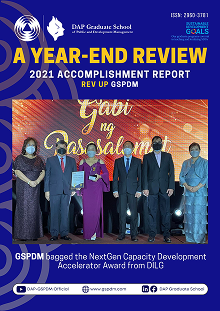
2021
GSPDM Accomplishment Report
ISSN: 2718-9112 (Print)
ISSN: 2960-3781 (Online)
2024
GSPDM Accomplishment Report
ISSN: 2960-3781 (Online)
2025
GSPDM Accomplishment Report
ISSN: 2718-9112 (Print)
ISSN: 2960-3781 (Online)
GSPM Accomplishment Reports
2019
GSPDM Accomplishment Report
ISSN: 2960-3781 (Online)
2020
GSPDM Accomplishment Report
ISSN: 2960-3781 (Online)
2021 GSPDM Accomplishment Report
ISSN: 2718-9112 (Print)
ISSN: 2960-3781 (Online)
GSPM Accomplishment Reports
2021
GSPDM Accomplishment Report
ISSN: 2718-9112 (Print)
ISSN: 2960-3781 (Online)
2024
GSPDM Accomplishment Report
ISSN: 2960-3781 (Online)
2025
GSPDM Accomplishment Report
ISSN: 2718-9112 (Print) ISSN: 2960-3781 (Online)
Academic Direction
GSPM aims to attain the following by 2030:
1
Teaching: New and revitalized academic programs, geared towards microcredentialing, and innovative learning methodologies
5
Funding: Regular GAA funding and increased revenue
2
Research: Enhanced research capabilities producing innovative and value-adding knowledge products
6
Linkages: Increased number of local and international linkages
3
Faculty: Diverse and sustainable pool of local and international faculty members
7
Facilities: Upgraded and complete facilities and equipment
4
Students: Increased number of local and foreign learners
8
Staff: Professionalized staff
Academic Direction towards 2024
GSPM
aims to
attain the
following
by 2024:
1
Implement new and revitalized academic programs with new learning methodologies;
5
Strengthen research capability by creating value-adding, relevant and innovative knowledge products;
2
Have a pool of organic local and adjunct international faculty;
6
Increase number of local and international linkages;
3
Increase number of local and foreign students;
7
Increase number of local and international linkages;
4
Receive regular funds from the government through the General Appropriations Act (GAA) and increase revenue;
8
Professionalize staff complement.
Academic Direction
GSPM aims to attain the following:
1
Implement new and revitalized academic programs with new learning methodologies;
2
Have a pool of organic local and adjunct international faculty;
3
Increase number of local and foreign students;
4
Receive regular funds from the government through the General Appropriations Act (GAA) and increase revenue;
5
Strengthen research capability by creating value-adding, relevant and innovative knowledge products;
6
Increase number of local and international linkages;